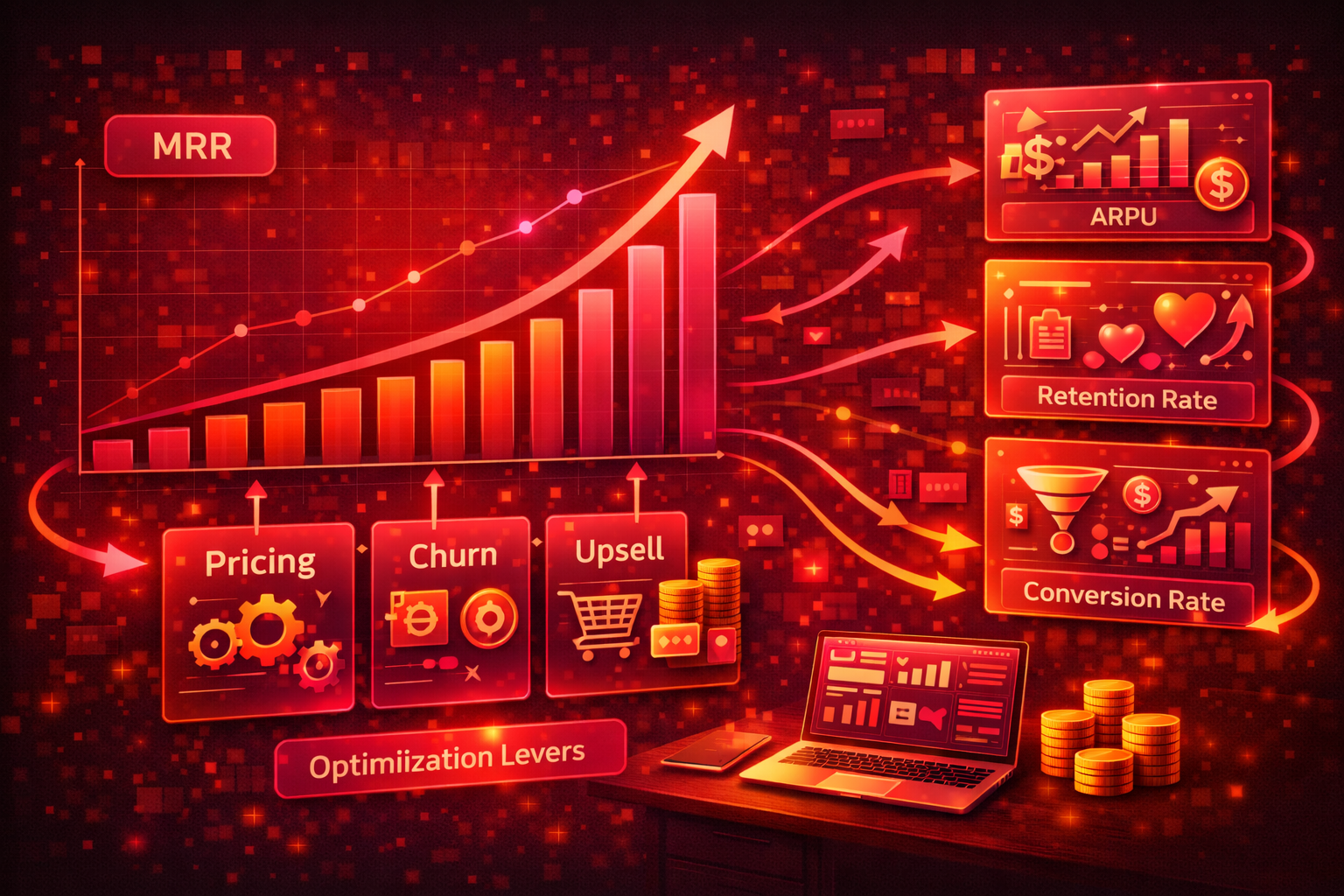
1. Introduction: The Hidden Revenue Leak in SaaS
Most SaaS founders focus on acquiring new customers while their subscription systems silently bleed revenue. A 2024 survey revealed that the average SaaS company loses 12-15% of potential revenue due to subscription management inefficiencies: failed payments that could be recovered, involuntary churn from expired cards, and revenue leakage from poor upgrade/downgrade flows.
The Reality Check:
If you're manually handling billing exceptions, losing customers to failed payments, or can't accurately forecast MRR, your subscription system is costing you more than just operational overhead—it's actively limiting your growth potential.
Subscription management is where customer experience meets revenue operations. A well-designed system doesn't just collect payments—it enhances customer lifetime value, enables growth experiments, and provides the data foundation for strategic decisions. This guide will walk you through building subscription systems that scale with your business while maximizing retention and revenue.
2. What SaaS Subscription Management Really Is
Beyond Billing Software: The Subscription Lifecycle
Subscription management encompasses the entire customer journey from signup to cancellation and everything in between:
Signup
Trial → Conversion
Billing
Invoicing → Payments
Renewal
Automatic → Manual
Expansion
Upgrades → Add-ons
Dunning
Failed payments → Recovery
Churn
Voluntary → Involuntary
Win-back
Reactivation → Retention
"Subscription management isn't a cost center—it's your most powerful revenue optimization tool. Every aspect should be designed to increase customer lifetime value."
3. Core Components of Subscription Management
The Subscription Management Stack
Pricing & Plans Management
The foundation of your revenue model
- Plan definitions: Tiered pricing, feature sets, user limits, usage quotas
- Pricing rules: Monthly/annual discounts, regional pricing, promotional codes
- Plan comparisons: Clear feature matrices, upgrade incentives, trial options
Billing Logic Engine
Intelligent calculation and application of charges
- Proration logic: Mid-cycle upgrades/downgrades, credit calculations
- Usage aggregation: Metered billing, overage charges, tiered usage
- Tax compliance: Automated tax calculations, VAT, GST, regional variations
Invoicing & Payment Processing
Professional billing experience and secure payment handling
- Invoice generation: Custom templates, branding, multiple currencies
- Payment methods: Credit cards, ACH, PayPal, bank transfers, digital wallets
- Payment gateway integration: Stripe, Braintree, Adyen, with failover options
Renewals & Expiration Management
Automated renewal flows and expiration handling
- Automatic renewals: Scheduled payment attempts, receipt generation
- Renewal notifications: Pre-renewal reminders, successful payment confirmations
- Expiration workflows: Grace periods, service degradation, final notices
Dunning & Payment Recovery
Intelligent handling of failed payments and revenue recovery
- Smart retry logic: Progressive delays, intelligent retry schedules
- Customer notifications: Failed payment alerts, update card reminders
- Payment method updates: Seamless card update flows, multiple attempt options
Upgrades & Downgrades
Seamless plan changes and feature adjustments
- Immediate vs. end-of-cycle changes: Customer choice, proration handling
- Feature access management: Instant feature enablement/disablement
- Credit management: Unused credit application, refund policies
Losing Revenue to Failed Payments?
Our subscription management systems recover 30-50% of failed payments automatically. Don't leave money on the table.
4. Billing Models in SaaS
Choosing the Right Billing Model
Monthly Billing
Fixed recurring charges each month
Pros:
- • Predictable revenue
- • Lower barrier to entry
- • Faster feedback cycles
Annual Billing
Prepaid yearly subscriptions with discounts
Pros:
- • Improved cash flow
- • Higher commitment
- • Reduced churn
Usage-Based Billing
Charges based on actual consumption
Pros:
- • Aligns cost with value
- • Scales with usage
- • Attractive to heavy users
Hybrid Models
Combination of fixed + variable pricing
Pros:
- • Predictable base + growth
- • Captures full value
- • Flexible for customers
When Complexity Kills Growth
Billing complexity directly impacts conversion rates and customer satisfaction. Each additional billing option or rule creates:
- 30-50% increase in support tickets related to billing
- 15-25% decrease in conversion rates on pricing pages
- 40-60% longer sales cycles for enterprise deals
Rule of thumb: Start with 2-3 simple plans, then add complexity only when you have data showing it will increase revenue.
5. Renewal Management & Retention
The Renewal Optimization Framework
Automatic vs. Manual Renewals
Automatic Renewals (Recommended)
- Renewal rate: 85-95% for successful payments
- Implementation: Clear opt-in, easy cancellation, pre-renewal notifications
- Best for: Low-cost plans, product-led growth, B2C
Manual Renewals (Enterprise)
- Renewal rate: 60-75% without intervention
- Implementation: 90/60/30 day reminders, dedicated account managers
- Best for: High-value contracts, procurement cycles, regulated industries
Renewal Notification Strategy
90 Days Pre-Renewal
Initial reminder + value recap. Focus on ROI demonstration and upcoming contract discussion.
30 Days Pre-Renewal
Renewal confirmation request. Include usage statistics, value metrics, and clear renewal instructions.
7 Days Pre-Renewal
Final reminder with urgency. Confirm payment method, highlight auto-renewal benefits.
Post-Renewal Confirmation
Thank you + receipt. Reinforce value, provide support contacts, encourage expansion.
Expansion vs. Contraction Revenue
Net Revenue Retention (NRR) is your most important SaaS metric. It measures revenue growth from existing customers after accounting for downgrades and churn:
Contraction
You're losing revenue from existing customers
Stable
Good retention, limited expansion
Growth
Expansion revenue exceeds churn losses
Target: Aim for 110%+ NRR. Top SaaS companies achieve 120-140% through systematic expansion revenue.
6. Churn: Why Customers Cancel
The Two Types of Churn
Voluntary Churn (30-40%)
Customers actively choosing to cancel. Root causes:
- Lack of value: Product doesn't solve their problem or ROI isn't clear
- Poor onboarding: Never reached "aha moment" or experienced core value
- Competition: Found better/cheaper alternative
- Budget constraints: Can't justify cost or reduced spending
Involuntary Churn (60-70%)
Customers lost due to payment failures. Root causes:
- Expired cards: 15-20% of credit cards expire annually
- Insufficient funds: Temporary account balance issues
- Bank declines: Fraud flags, unusual activity patterns
- Technical issues: Payment gateway downtime, network errors
Billing-Related Churn: The Silent Revenue Killer
Our analysis of 50+ SaaS platforms shows billing issues account for 40-60% of all churn, yet most companies focus product improvements instead of fixing payment problems:
| Billing Issue | % of Churn | Recovery Rate | Solution |
|---|---|---|---|
| Expired credit cards | 25-35% | 60-80% | Smart card updaters, pre-expiration reminders |
| Insufficient funds | 15-25% | 40-60% | Intelligent retry logic, grace periods |
| Confusing invoices | 10-15% | 70-90% | Clear billing, proactive support |
| Unexpected charges | 5-10% | 20-40% | Transparent pricing, usage alerts |
Build a Subscription System That Scales With Growth
Don't let billing complexity limit your SaaS potential. Our subscription systems handle millions in revenue with 99.9% accuracy.
7. Churn Reduction Strategies
Systematic Churn Prevention Framework
Smart Dunning Flows
Intelligent payment recovery sequences that adapt based on customer behavior and payment history:
Attempt 1 (0-3 days)
Automated retry + gentle email notification. 40-50% recovery.
Attempt 2 (4-7 days)
Second retry + more urgent email. 20-30% additional recovery.
Attempt 3 (8-14 days)
Final retry + phone call/SMS. 10-15% final recovery.
Pro tip: Use payment history to customize dunning. Good payers get more attempts, risky customers get fewer.
Failed Payment Recovery
Card Updater Services
Automatically update expired or replaced cards using Visa Account Updater, Mastercard Automatic Billing Updater, etc.
Recovery rate: 60-80% of expired cards
Intelligent Retry Logic
Schedule retries based on failure type, customer value, and historical success patterns.
Best times: 3 days, 7 days, 14 days after failure
Grace Periods & Service Degradation
Instead of immediate cancellation, implement progressive service reduction:
Full Service (Days 0-7)
All features available, prominent payment reminders
Limited Service (Days 8-14)
Read-only access, export capabilities, core features only
Suspended (Day 15+)
Data preserved, account inaccessible, final cancellation warnings
Subscription Analytics & Alerts
Proactive churn prediction and intervention:
Churn Risk Scoring
- Usage decline patterns (last 30 days vs. previous)
- Payment history and failure frequency
- Support ticket volume and sentiment
Proactive Interventions
- High-risk alerts to customer success team
- Targeted retention offers (discounts, add-ons)
- Personalized check-in calls or demos
8. Subscription Metrics You Must Track
The SaaS Revenue Dashboard
MRR & ARR
Monthly/Annual Recurring Revenue
Key Insights:
Growth rate, new vs. expansion, churn impact
Net Revenue Retention
(Starting MRR + Expansion - Churn) / Starting MRR
Target:
110%+ for healthy growth
Churn Rate
Customer & Revenue Churn
Benchmark:
3-7% monthly for B2B SaaS
LTV & ARPU
Lifetime Value & Average Revenue Per User
Goal:
LTV:CAC ratio > 3:1
Advanced Metrics for Growth
Quick Ratio
(New MRR + Expansion MRR) / (Churned MRR + Contraction MRR)
Magic Number
(Current Quarter Revenue - Previous Quarter Revenue) × 4 / Previous Quarter Sales & Marketing Spend
Rule of 40
Revenue Growth Rate + Profit Margin
9. Subscription Management Architecture
Building Scalable Subscription Systems
Data Consistency & Integrity
Subscription data must be accurate and consistent across all systems. Common pitfalls:
Problem: Dual-Write Issues
Writing to database and payment processor independently creates inconsistencies during failures.
Customer charged but subscription not created
Solution: Event-Driven Architecture
Use event sourcing or outbox pattern to ensure atomic operations.
Single source of truth with eventual consistency
Scalability Considerations
Database Design for Subscriptions
- Time-series data: Store subscription events (created, updated, canceled) for audit trails
- Read/write separation: Separate analytics queries from transactional operations
- Indexing strategy: Optimize for common queries: active subscriptions, upcoming renewals, failed payments
Handling Peak Loads
- Batch processing: Schedule renewal processing during off-peak hours
- Queue systems: Use message queues for async payment processing and dunning flows
- Rate limiting: Implement smart rate limiting with payment processors
Integration Architecture
Subscription systems don't exist in isolation. They must integrate with:
Product & Feature Flags
Real-time feature access based on subscription status and plan entitlements.
Analytics & BI Tools
Export subscription data to analytics platforms for cohort analysis and forecasting.
CRM & Support Systems
Sync subscription data to CRM for sales insights and support context.
Key principle: Treat your subscription system as the single source of truth for all entitlement and billing data. All other systems should consume from it, not duplicate logic.
10. Common Subscription Management Mistakes
Avoid These Costly Errors
1. Over-Engineering Billing Logic
Building complex pricing engines before validating your pricing model:
- Implementing 10-tier pricing before knowing which features customers value
- Building custom proration logic when simple end-of-cycle changes would work
- Creating complex discount systems that confuse customers and sales teams
Solution: Start with 2-3 simple plans. Add complexity only when you have data showing it increases revenue.
2. Ignoring Analytics & Metrics
Not tracking the right subscription metrics or acting on the insights:
- Only tracking MRR without analyzing expansion vs. churn components
- Not implementing cohort analysis to understand long-term customer value
- Failing to set up alerts for unusual churn patterns or payment failure spikes
Solution: Implement a subscription analytics dashboard from day one. Track at least MRR, churn, LTV, and NRR.
3. Manual Processes at Scale
Attempting to manage subscriptions manually as volume grows:
- Manually processing upgrades/downgrades instead of self-service
- Hand-rolling invoices or managing failed payments in spreadsheets
- Not automating dunning processes, leading to preventable churn
Solution: Automate everything possible by 100 customers. Manual processes don't scale beyond 1,000 customers.
11. How Flecible Designs Scalable Subscription Systems
Our 3-Phase Subscription System Methodology
1. Strategy-First Billing Design
We start with your business goals and customer needs, not technical implementation. Our process includes pricing strategy validation, competitive analysis, and revenue modeling before any code is written.
2. Revenue-Aligned Architecture
We build subscription systems that align with your revenue goals, not just technical requirements. This includes automated revenue recovery, expansion revenue optimization, and churn prediction systems.
3. Long-Term Scalability Partnership
We don't just build and leave. We provide ongoing optimization, performance monitoring, and scaling support as your subscription volume grows from hundreds to millions of transactions.
Case Study: 40% Reduction in Involuntary Churn
For a SaaS platform with 10,000+ subscribers, we implemented a comprehensive subscription management system that included:
Reduction in involuntary churn
Increase in expansion revenue
Failed payment recovery rate
"Flecible's subscription system recovered $125,000 in lost revenue in the first 90 days through automated payment recovery alone." — SaaS Platform CEO
12. Conclusion: Key Takeaways & Next Steps
Subscription Management Success Checklist
Do This Now:
- Implement automated dunning for failed payments
- Set up subscription analytics tracking MRR, churn, and NRR
- Create clear renewal notification sequences
- Simplify pricing to 2-3 core plans with clear value
Stop Doing This:
- Manual billing processes that don't scale
- Ignoring involuntary churn from payment failures
- Complex pricing that confuses customers
- Treating subscription management as just billing
Your 30-Day Action Plan:
- 1 Audit your current churn: Separate voluntary vs. involuntary, analyze root causes
- 2 Implement basic dunning: Set up 3-step email sequence for failed payments
- 3 Create subscription dashboard: Track MRR, churn rate, and NRR weekly
- 4 Plan system upgrade: Document requirements for scalable subscription management
Remember: Your subscription management system is the revenue engine of your SaaS business. Every improvement directly impacts your bottom line. By implementing the strategies in this guide, you can reduce churn, recover lost revenue, and create subscription experiences that customers love and stick with for years.
Written by Flecible — SaaS Revenue & Subscription Experts
With experience building subscription systems processing over $500M in annual recurring revenue, our team has solved subscription management challenges for SaaS companies from startup to enterprise. We've designed systems that reduce churn by 40%, recover 85% of failed payments, and increase expansion revenue by 30%+.